


Since October 17, 2024, the NIS2 directive has forced tens of thousands of European companies to raise their cybersecurity game. By the day the rules took effect, fewer than 30% of in-scope organizations were actually compliant. A few months later, on January 17, 2025, DORA started regulating digital resilience across financial services. And between February 2025 and August 2026, the EU AI Act is rolling out its obligations in successive waves. Three frameworks, three timelines, one question every CISO needs to answer: is your AI legally defensible ?
AI cybersecurity compliance isn’t a checkbox anymore, and it isn’t a purely legal problem either. It has become an operational program that lands directly on your models, your data pipelines, your monitoring stack and your incident response. The fines tell you everything you need to know: up to €10 million or 2% of global revenue under NIS2, and up to €35 million or 7% of revenue under the AI Act.
This guide gives CISOs and CIOs the full picture of the three frameworks that now shape their work. It maps the obligations that overlap, pinpoints the AI capabilities you genuinely need to comply without blowing the budget, and lays out a practical 2026-2027 roadmap that turns regulatory pressure into a competitive edge.
NIS2, DORA and the AI Act: why three frameworks converge in 2026
Europe made a deliberate political choice: stack vertical regulations rather than cram everything into a single text. The operational consequence is that the same CISO can find themselves on the hook for all three at once. Understanding how the texts fit together is the first step toward compliance that actually works.
NIS2: 10 obligations that reach every part of your AI
NIS2 covers 18 critical sectors: healthcare, energy, finance, transport, telecoms, water, digital infrastructure, public administration, space, food, chemicals, manufacturing, and more. Article 21 lays out 10 cybersecurity obligations, from risk management and continuous training to incident disclosure within 24 hours.
For IT leaders, the critical point is this: every one of those obligations applies to your AI systems too. Behavioral detection models, internal LLM assistants, customer recommendation engines, they all sit inside the scope, even though the text doesn’t name them explicitly.
DORA: digital resilience for financial services
In force since January 17, 2025, DORA targets banks, insurers, asset managers, fintechs, and their third-party providers. Its five pillars, ICT risk management, incident reporting, resilience testing, third-party oversight and information sharing, overlap heavily with NIS2 but raise the bar.
One detail often overlooked: DORA also reaches the cloud and AI providers that serve financial institutions. If you run an AI platform used by a European bank, you’re now subject to its continuity and auditability obligations, no matter where your offices sit on the continent.
AI Act: classification by risk level
The AI Act takes a different angle. It sorts AI systems into four buckets, prohibited, high-risk, limited risk, minimal risk and applies proportionate obligations. The prohibitions kicked in on February 2, 2025. Obligations for high-risk AI become enforceable on August 2, 2026.
Article 15 is the one CISOs should bookmark. It demands an appropriate level of cybersecurity and robustness for any high-risk AI system. Translation: your models need to survive data poisoning, model inversion and adversarial attacks. That is exactly AI cybersecurity territory.
The 4 AI capabilities you can’t comply without
Tackling three frameworks with traditional tools is a fast track to documentation drowning. The CISOs who get compliance right build four foundational capabilities, all of which lean on AI itself.
Continuous inventory and mapping. No compliance is possible without an exhaustive inventory of AI systems in production, their data flows and their dependencies. Manual approaches based on questionnaires age within weeks. An AI-driven inventory wired into your IT stack keeps the map fresh in real time.
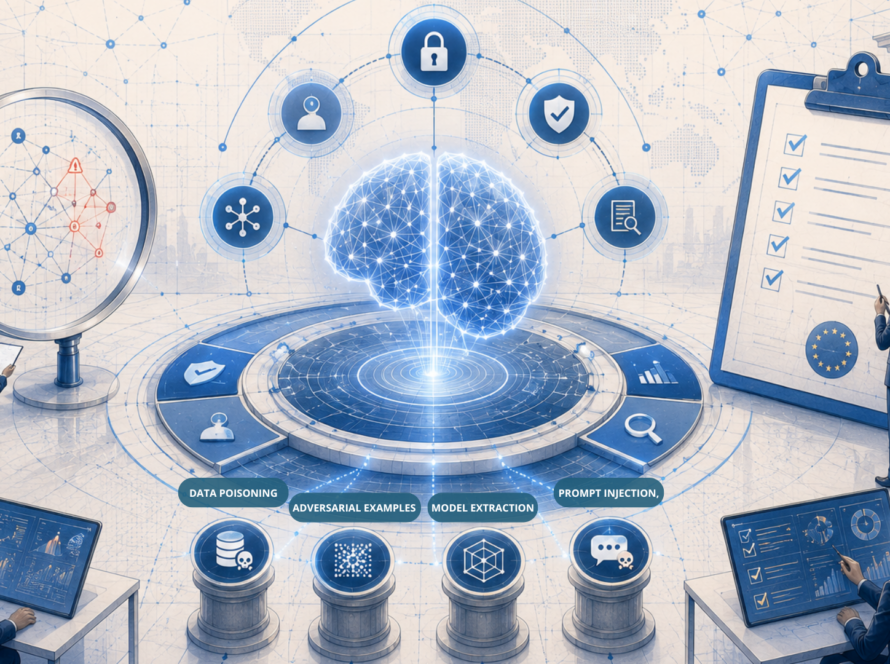
Behavioral detection and anomalies. Signature-based logic in traditional SIEMs misses attacks on the AI layer itself: adversarial inputs, prompt injection, model extraction. An AI-augmented cybersecurity layer flags behavioral drift and produces the evidence of control that regulators expect to see.
Automated incident reporting. NIS2 demands notification within 24 hours; DORA gives you 4 hours for qualified major incidents, with an interim report at 72. Without automation, those windows are out of reach. Incident flows need to be structured, qualified and routed to the right authority in near real time, exactly the kind of workflow an AI-driven SOC orchestrates natively.
Continuous model auditing. The AI Act calls for living technical documentation: model registry, datasheets, model cards, plus post-deployment drift monitoring. Explainable AI tools (SHAP, LIME, counterfactuals) become a prerequisite, not a nice-to-have.
Mapping the three frameworks: where they meet, where they diverge
Calendar dates only get you so far. What really shapes a CISO’s day is how the obligations actually connect. The table below gives you a working grid.
| Dimension | NIS2 | DORA | AI Act |
| Scope | 18 critical sectors | Financial services + ICT providers | Any AI system placed on the EU market |
| Entry into force | 17/10/2024 | 17/01/2025 | 02/02/2025 → 02/08/2026 |
| Cyber obligations | 10 (Article 21) | 5 pillars | Article 15 (high-risk) |
| Incident notification | 24h (early warning) | 4h (major incidents) | Varies by category |
| Maximum penalty | €10M or 2% of global revenue | Significant fines, up to 1% of average daily revenue | €35M or 7% of global revenue |
| Approach | Sector-based | Financial sector | Cross-sector, by risk level |
Three operational takeaways come out of that grid. First, a financial institution regulated under DORA, deploying high-risk AI, and operating in a sector covered by NIS2 has to build one single system that satisfies all three. That describes most major European banks today.
Second, the cybersecurity obligations converge around governance, risk management, continuous monitoring and incident reporting, but the deadlines and the authorities differ. The real operational risk isn’t non-compliance in itself; it’s inconsistent multi-reporting that ends up triggering inspections.
Third, the AI Act layers in something NIS2 and DORA didn’t have: adversarial robustness, decision traceability and bias documentation. A purely AI topic that becomes a cyber topic the moment you push it to production.
A practical 2026-2027 roadmap for CISOs
The AI Act spells out 8 key obligations. Most European companies haven’t cleared the first one: the inventory. Before you build an ambitious roadmap, give yourself 90 days to land the basics.
Quarter 1 (90 days) : mapping and urgent items. Complete inventory of AI systems and their data flows. AI Act classification (prohibited / high / limited / minimal). Gap analysis against Article 21 of NIS2. Stand up the model registry. Appoint an AI-cyber lead at the executive level. This quarter doesn’t need heavy tooling investment, but it does need cross-functional mobilization across IT, business and legal.
Quarters 2 and 3 (6 months) : structuring. Deploy a continuous AI monitoring layer. Upgrade your behavioral detection setup. Industrialize incident reporting. Launch an adversarial robustness audit on high-risk models. Run the first round of NIS2 and ISO 27001 training for IT and business teams.
Quarters 4 to 6 (12 to 18 months) : industrialization. Exhaustive coverage of production models. Quarterly adversarial testing. Compliance KPIs embedded in C-level reporting. Preparation for inspections by ANSSI, ACPR, or the notified AI authority. This is the stage where compliance turns into a commercial asset, especially when you’re pitching public-sector and financial buyers.
Why AI cybersecurity compliance is now a competitive advantage
Too many organizations still treat compliance as a cost. That’s a framing error. The CISOs who got out ahead of NIS2 and the AI Act are winning bids today because they can prove, audit in hand, what their competitors only claim on a slide.
Sovereign, explainable, resilient AI isn’t a slogan anymore. It has become a procurement requirement in banking, insurance, automotive, aviation, rail and the public sector. At Neo Cœur Intelligence (NCI), we see RFPs where buyers now ask for the NIS2 × ISO 27001 × AI Act mapping right in the brief. Not having that map costs contracts.
The good news is that the foundations are largely shared. A clean AI inventory, continuous monitoring, automated reporting and a robustness audit cover most of the three frameworks. That is exactly what an Intelligent Supervision Center and an AI-augmented cybersecurity approach deliver.
Conclusion: turning constraint into strategic momentum
AI cybersecurity compliance in 2026 boils down to a simple equation: three European frameworks : NIS2, DORA, AI Act, that together impose an operational discipline no one was used to. The good news is the obligations converge around four structural AI capabilities: continuous inventory, behavioral detection, automated reporting and explainable auditing. The bad news is that the deadlines are already tight and the penalties go beyond what any serious organization can absorb.
The right move isn’t to wait for your first inspection to act. Map what your organization deploys in AI today, identify the gaps, and prioritize a 90-day plan that unlocks the foundations. The exercise doesn’t take big budgets. It takes discipline and the right method.
Assess your AI risk exposure in 5 minutes
Get an actionable score against NIS2, DORA, and the AI Act, plus a clear roadmap for the next 90 days.


2 Comments
Ronald NOUBI
Great and very timely article.
Thank you for sharing this practical guide on AI compliance, cybersecurity and regulatory readiness.
For CISOs, CIOs, cybersecurity experts and risk leaders, the key message is clear: AI is no longer only about innovation. It must now be secure, explainable, auditable and legally defensible.
With NIS2, DORA and the EU AI Act, organizations will need more than policies. They will need a clear AI inventory, continuous monitoring, incident reporting capabilities and strong model governance.
This is especially important for highly regulated sectors such as banking, insurance, public services and critical infrastructure.
AI compliance should not be seen only as a constraint. It is becoming a real trust and competitive advantage.
A very useful read for anyone working on cybersecurity, AI governance, risk management or digital resilience.
#Cybersecurity #AICompliance #NIS2 #DORA #AIAct #RiskManagement #DigitalResilience #Governance
Herman NOUBOUM NOUBI
Thank You my brother